FDA Updates OTC Sunscreen Requirements
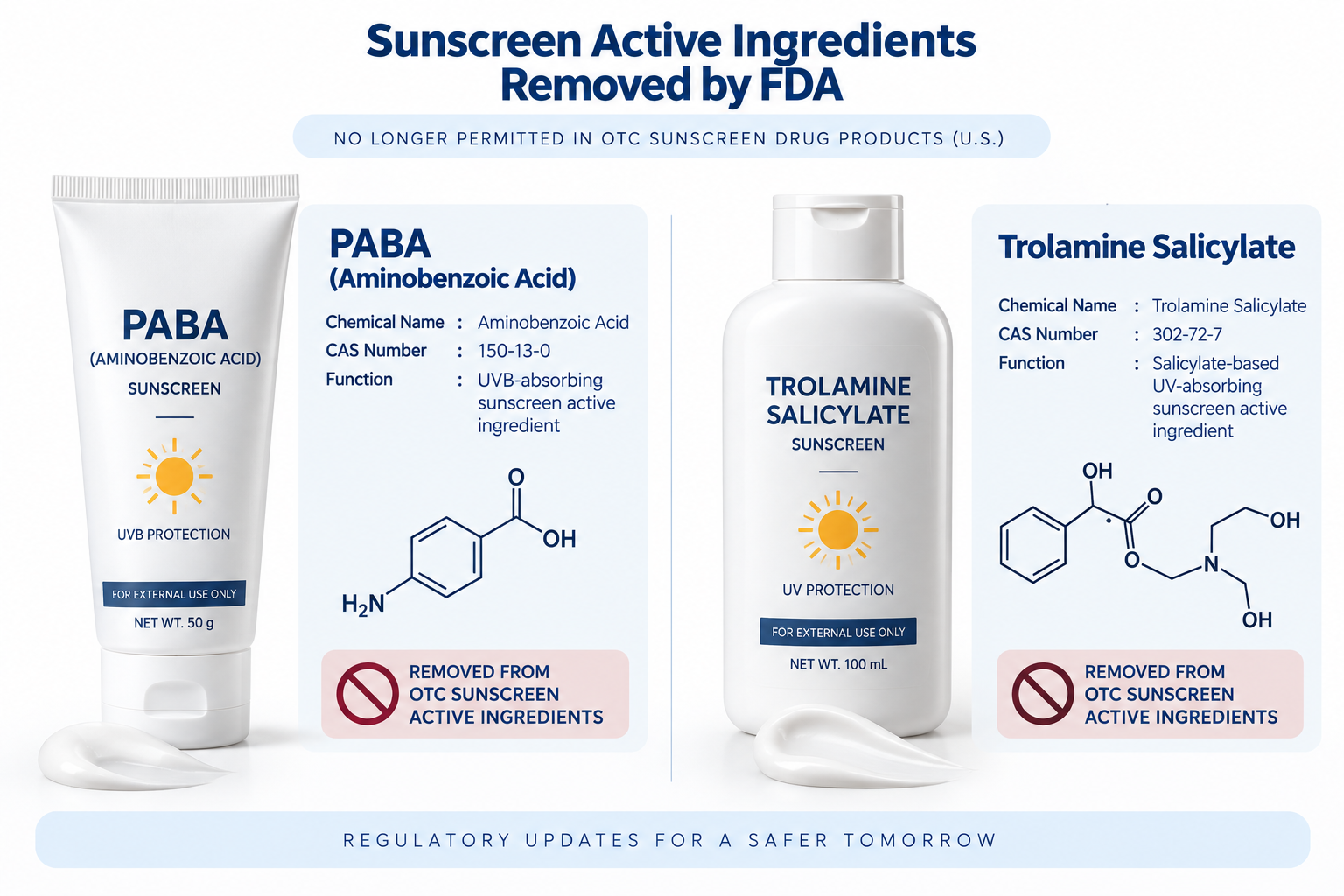
The U.S. Food and Drug Administration (FDA) has issued a Final Administrative Order addressing the regulatory status of two sunscreen active ingredients — PABA (Aminobenzoic Acid) and Trolamine Salicylate. Under the final order, these two ingredients are removed from the active ingredients permitted for use in over-the-counter (OTC) sunscreen drug products under the U.S. sunscreen monograph.
FDA determined that, based on the available information, the risks associated with these ingredients outweigh their benefits when used as active ingredients in sunscreen drug products. Once the final order becomes effective, sunscreen drug products containing PABA or Trolamine Salicylate cannot be marketed in the United States without FDA approval.
Which Sunscreen Ingredients Have Been Removed?
1. PABA (Aminobenzoic Acid)
- PABA, or aminobenzoic acid, has historically been used as a UVB-absorbing active ingredient in sunscreen formulations.
- Following its evaluation of the available safety and benefit-risk information, FDA has removed PABA from the permitted active ingredients under the OTC sunscreen monograph.
- This means that, once the final order takes effect, sunscreen drug products containing PABA will no longer be eligible for marketing under the applicable OTC sunscreen monograph without FDA approval.
2. Trolamine Salicylate
- Trolamine Salicylate is a salicylate-based UV-absorbing active ingredient that has also been used in sunscreen products.
Following FDA’s review of the available safety and benefit-risk information, Trolamine Salicylate has also been removed from the permitted OTC sunscreen active ingredients.
As with PABA, products containing Trolamine Salicylate will require FDA approval to be marketed in the U.S. once the final order becomes effective.
What Does the Final Order Mean for Sunscreen Manufacturers?
The update highlights the importance of continuously monitoring regulatory developments affecting sunscreen formulations and OTC drug products.
Manufacturers, formulators, marketers, and other stakeholders should review their products and regulatory strategies to ensure alignment with the updated requirements.
Key considerations may include:
- Reviewing existing and proposed sunscreen formulations for PABA and Trolamine Salicylate.
- Assessing regulatory compliance of products intended for the U.S. market.
- Reviewing product labeling, claims, specifications, and supporting documentation where applicable.
- Ensuring appropriate quality and analytical testing throughout product development and manufacturing.
- Monitoring further FDA updates to the OTC sunscreen monograph.
For organizations developing new sunscreen products for the U.S. market, early regulatory assessment can help identify potential compliance issues before commercialization.
What Does This Mean for Consumers?
According to FDA, this regulatory action is not expected to affect sunscreen products currently available on U.S. store shelves because the agency is not aware of any sunscreens currently marketed in the United States that contain either PABA or Trolamine Salicylate.
Therefore, consumers do not need to take any action as a result of this order. Consumers should continue using sunscreen as directed and follow other recommended sun-protection measures, such as seeking shade and using protective clothing when appropriate.
Part of the Broader Modernization of Sunscreen Regulation
The removal of these two ingredients is part of FDA’s broader work to modernize the regulatory framework governing OTC sunscreen drug products.
This process is being carried out under the Coronavirus Aid, Relief, and Economic Security (CARES) Act of 2020, which introduced a new administrative order process for establishing and updating OTC drug monographs. FDA issued a proposed sunscreen order in September 2021, which received more than 15,000 public comments.
The agency continues to evaluate other important aspects of sunscreen regulation, including matters related to:
- SPF levels
- Labeling requirements
- Permitted dosage forms
- Other provisions of the OTC sunscreen monograph
For sunscreen manufacturers and other stakeholders, this means the regulatory landscape may continue to evolve as additional FDA decisions are finalized.
Why Regulatory Monitoring Matters
Sunscreens occupy an important intersection between product safety, analytical science, formulation development, quality control, and regulatory compliance. Changes to the regulatory status of an active ingredient can have implications throughout a product’s lifecycle — from formulation and testing to labeling and market authorization.
Regular monitoring of regulatory developments can therefore help manufacturers:
- Identify potential compliance gaps early.
- Evaluate formulations against current requirements.
- Maintain appropriate product quality and safety standards.
- Prepare for changes in regulatory expectations.
- Support smoother product development and market-entry decisions.
How Choksi Laboratories Supports Manufacturers
At Choksi Laboratories Limited, we support pharmaceutical, cosmetic, personal care, and related industries with advanced analytical capabilities and scientific expertise. Our services help manufacturers strengthen their approach to product testing, quality assurance, regulatory compliance, and product development as global requirements continue to evolve.
By combining reliable analytical testing with technical and regulatory expertise, we help organizations make informed decisions and maintain confidence in the quality, safety, and compliance of their products.
For businesses operating in regulated markets, having access to dependable testing and scientific support can be an important part of responding effectively to changing regulatory requirements.
Stay Prepared for Evolving Sunscreen Regulations
FDA’s decision regarding PABA and Trolamine Salicylate reinforces the need for manufacturers to remain informed about changes to the U.S. OTC sunscreen regulatory framework.
As FDA continues its review of other sunscreen monograph provisions, companies should continue assessing their formulations, testing strategies, labeling, and regulatory requirements to ensure ongoing compliance.
Need analytical testing or regulatory support for your pharmaceutical, cosmetic, or personal care products?
Contact Choksi Laboratories Limited
📧 bd@choksilab.in
🌐 www.choksilab.in